When we watch a race, our attention usually goes to the riders: the ones launching attacks, the ones setting the pace at the front of the peloton, or the one crossing the finish line first. But behind every cyclist there’s a massive machine at work: a professional team with a complex structure, dozens of staff members, and a budget that averages around €32 million among WorldTeams, sometimes exceeding €50 million.
Understanding how teams operate is key to understanding how races are won or lost.
What types of cycling teams exist?
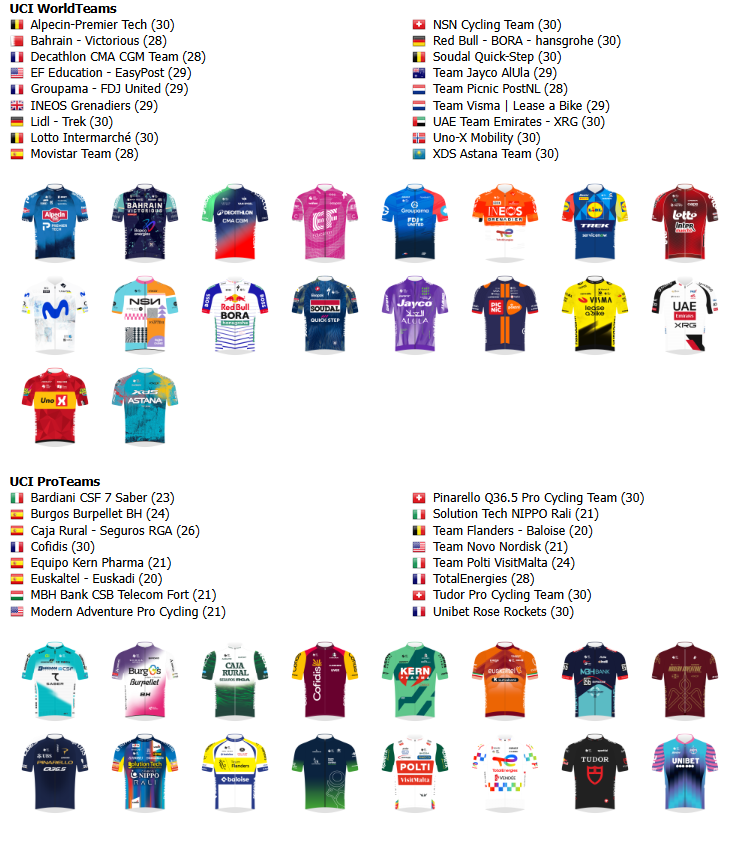
As we mentioned in the previous article on race categories, professional cycling is structured into three main team tiers:
UCI WorldTeams: the elite of global cycling.
UCI ProTeams: the second tier. They can qualify for or receive invitations (wild cards) to compete in WorldTour events.
UCI Continental Teams: the third tier. Here you’ll find development squads affiliated with WorldTeams, smaller professional teams focused on national or continental races, and semi-pro teams.
Club Teams: the fourth tier. These include development teams linked to ProTeams and Continental teams, along with countless clubs made up of young amateur riders. Many of today’s top stars started in these squads racing amateur and semi-pro events.
How many riders are on a professional cycling team?
A typical WorldTeam roster includes around 25–30 riders. Teams in the lower tiers—ProTeams and Continental teams—usually have a similar number, depending on their budget and the number of races they plan to contest.
However, only 7 or 8 riders per team start most races (sometimes just 6 in smaller events). That’s why rosters are built to cover the entire season and run multiple race programs simultaneously. While one group may be racing the Tour de France, another might be competing at the Tour of Austria or in a one-day race in Belgium.
How is a cycling team organized?
Even though the riders are the ones pedaling, pro teams operate much like full-scale sports organizations.
Here’s what a typical setup looks like:
- General Manager / Team Manager: responsible for overall management, the budget, securing sponsors, and signing riders.
- Sports Directors: plan race strategy, decide which riders go to each race, and give instructions from the team car during the event.
- Coaches and Performance Staff: oversee training plans, monitor rider performance, and manage recovery.
- Mechanics and soigneurs: the backbone of the team. Mechanics keep the bikes in perfect condition, while soigneurs look after the riders’ recovery after each stage.
- Doctors and nutritionists: supervise health, diet, and recovery.
- Communications, logistics, and marketing staff: manage the team’s image and relationships with sponsors and the media.
A WorldTour team can easily have more than 60 staff members. That number grows even larger when the organization also runs a development squad, since both teams typically operate under the same structure.
What kind of budget does a cycling team have?
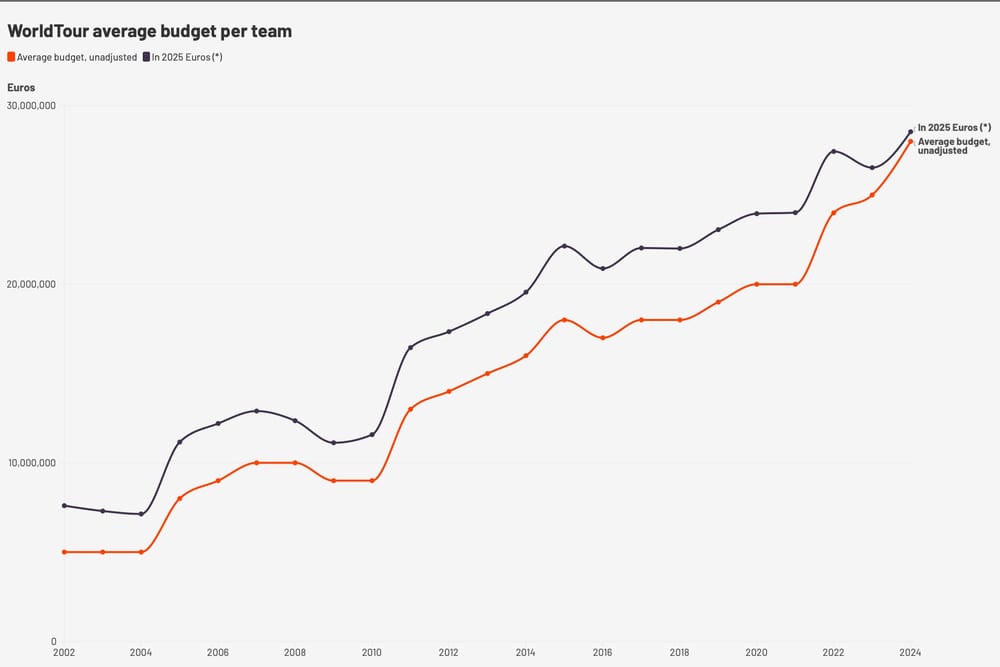
Teams rarely publish exact financial figures, so most available data comes from cycling media and fan-driven databases that attempt to estimate realistic numbers.
In 2025, the average WorldTeam budget hits about €32 million, rising steadily each year. Much of that comes from sponsors with deep pockets, like UAE Team Emirates.
When a team with virtually “unlimited” resources can sign top riders and keep pouring into performance, the rest of the peloton has to scramble for funding and talent just to stay competitive.
Like in many sports, the gap in budgets and salaries between teams sparks debate, especially when one or two squads dominate to the point of limiting the competition. Even within the WorldTeams, financial disparities are striking: the biggest budget can be three times the smallest.
A similar dynamic exists among ProTeams. Some of these squads were once WorldTeams and still run with similar budgets and setups, which raises both the competition and the financial stakes in the second tier. The average budget now sits at about €9.4 million, up from €5.8 million in 2022.
The effects of this constant need for more money are visible every year: teams searching for new sponsors, rumors of sales and mergers, questions about their future… For example, this year one WorldTeam, Arkéa–B&B Hotels, disappeared, while two others—a ProTeam and a WorldTeam—merged to form Lotto-Intermarché.
How are professional cycling teams financed?
Cycling doesn’t generate ticket revenue the way many other sports do. While some races sell VIP passes for certain sections of the course, such as at the Tour of Flanders, teams themselves do not receive revenue from television rights. That money goes to race organizers.
The biggest race organizers include companies like Amaury Sport Organisation, RCS Sport, and Flanders Classics, which run many of the sport’s most important events.
As a result, team funding depends almost entirely on sponsors.
That’s why teams carry company names: INEOS Grenadiers, Soudal Quick-Step, Movistar Team, or national sponsors like UAE or Bahrain.
Team cars, buses, bikes, jerseys, and bib shorts all become moving billboards. The more airtime a sponsor gets on TV, the better. That’s one reason teams are often eager to place riders in breakaways: it increases visibility for the companies funding the operation.
In return for that exposure, especially in major races like the Tour de France, sponsors invest millions of euros each year. Sometimes that investment comes in the form of equipment rather than cash, and in many cases it’s a combination of both.
Bike manufacturers, component brands, apparel companies, and other technical partners all want visibility in the pro peloton so fans see their logos and products. For bike brands in particular, having a presence in the WorldTour is extremely valuable but securing a spot with a top team can be difficult. That’s why companies like Decathlon have opted to purchase a WorldTour team outright to guarantee visibility for their cycling brands.
And what about prize money? For WorldTour teams, it’s not a major part of the budget. Even the Tour de France doesn’t award enough prize money to make a significant impact. In 2025, the distribution was as follows:
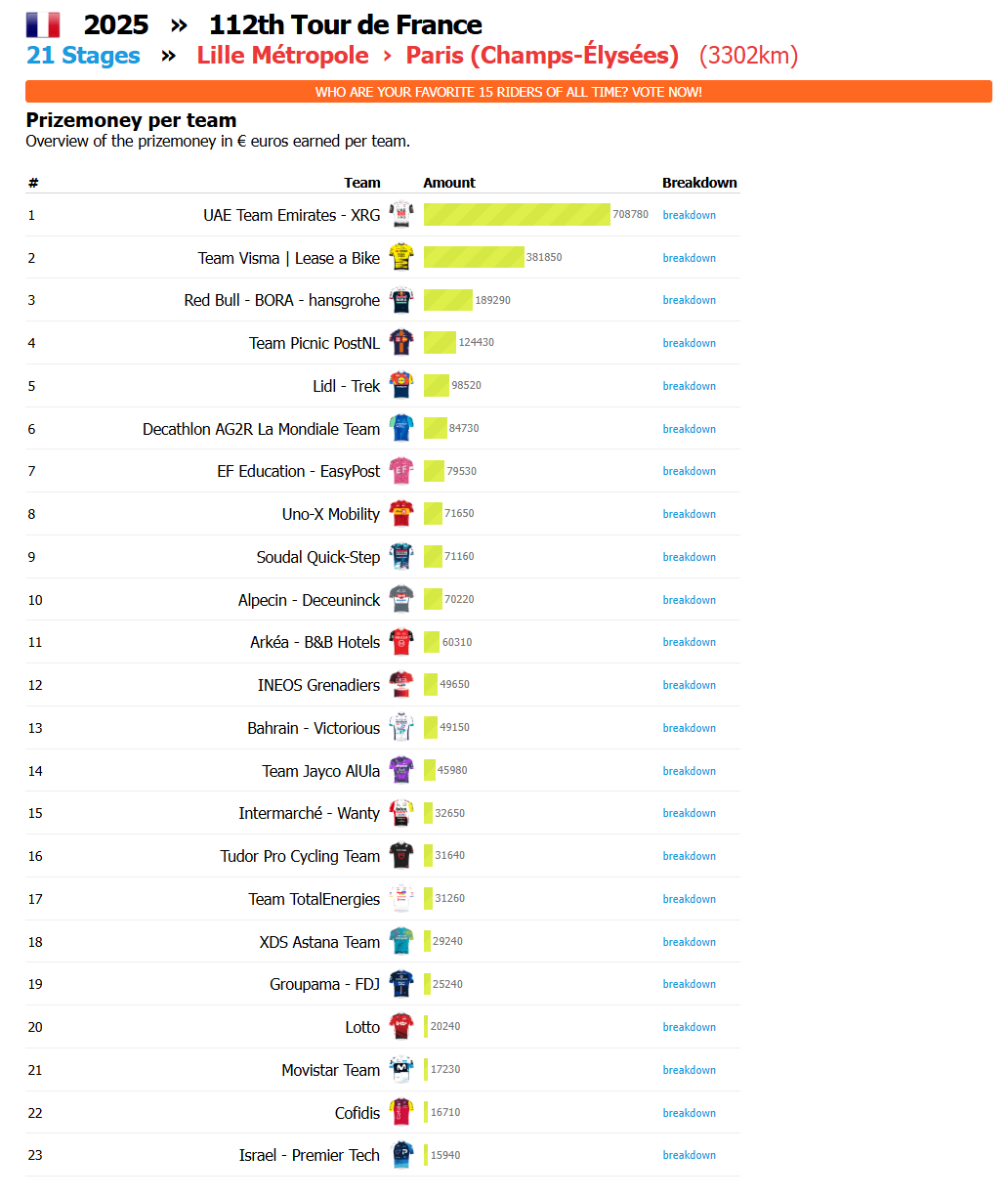
The total prize pool was €2.3 million, shared among 23 teams, with more than 50% going to just three teams (source: ProCyclingStats).
Without sponsors, the current financial model simply wouldn’t be sustainable.
What does a cycling team spend its budget on?
Most of a team’s budget isn’t spent on bikes or luxury hotels; it’s spent on people.
The largest expense is salaries. A significant portion of the budget goes toward paying riders and staff.
The rest typically goes toward:
- Travel and logistics: transportation, accommodation, and meals for dozens of staff members and vehicles traveling across Europe for months at a time.
- Technical equipment: bikes, wheels, components, apparel, and accessories. Anything not provided by sponsors or technical partners has to be purchased. In many cases, manufacturers supply most of the equipment—especially to top teams—because of the visibility they receive.
- Medical care, nutrition, and performance: testing, medical checkups, nutrition support, training programs, and performance data software.
- Communications and marketing: content production, social media, public relations, and sponsor services.
- Development and talent pipeline: training young riders and supporting feeder teams or talent-identification programs.
Simply put, pro cycling doesn’t pour as much money into “gear” as other sports. The bulk of the budget keeps a large team and logistical system running nearly year-round.
What’s coming in the next article?
Now that you understand how teams are structured and who’s behind every win, the next article will dive into the lives of professional cyclists: how they train, how much they earn, how contracts and transfers work, and what it takes to stay at the top level throughout a full season.
Behind every race number is a story of sacrifice, dedication, and passion. More than the millions or the technology, that’s still the true heart of cycling.