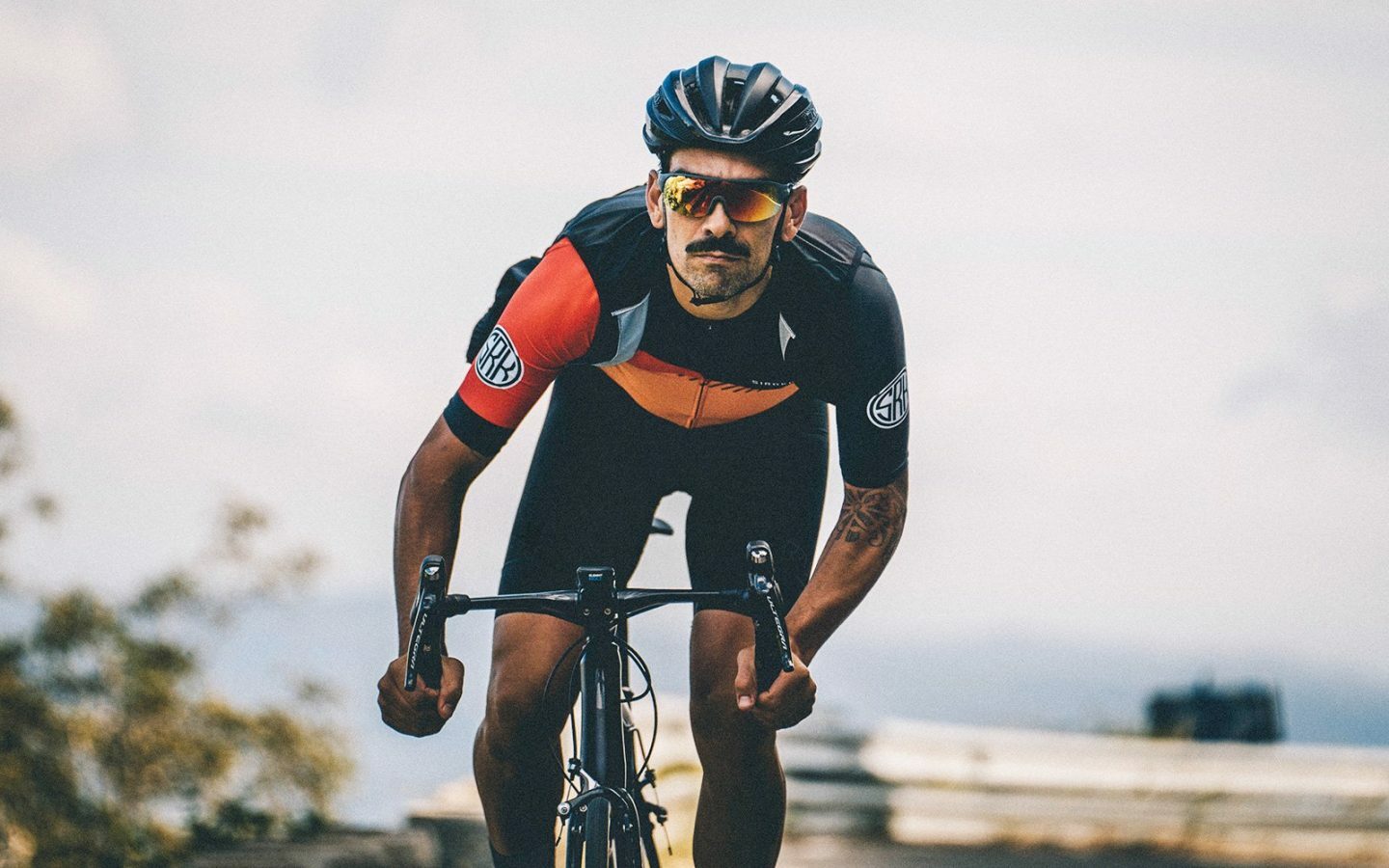
Choosing the right size of cycling apparel is vital as it guarantees top performance of our garments: comfort, breathability, insulation and ease of body movement at the same time.
As shopping online is gaining in popularity, knowing our measurements becomes crucial since we do not have the chance to try on clothes in a physical store. In order to answer the question “What is my size?” as accurately as possible, you need to know your current body measurements. It may seem like a lot of hassle but it is better to take a few minutes to measure yourself than to buy the wrong size and have to return it.
How to take your measurements?
To take your measurements you will need a sewing tape measure. If you don’t have one, you can use a regular measuring tape or a ruler as a last resort, but it is not recommended.
A pencil and a piece of paper will come in handy to write down your measurements. You can also use your smartphone to take notes of the measurements and always have them at hand.
You should take your measurements with your clothes off. Do not do it with a jersey or a jacket on because you will surely end up choosing a size that’s too big for you.
The sewing tape measure should fit closely around your body. Do not tighten it too much or let it be too loose.
What should you measure?
There are three main measurements: chest, waist and hips. The first two plus your torso length will help you choose garments such as a jersey, base layer, vest or jacket. The last two plus the length of your inseam (inside leg) are the measurements you need for bib shorts.
- To measure your chest, place the tape under your armpit at the widest part of the chest. For women, the tape measure should go over the nipples, never under or over the breasts.
- To measure your waist, measure yourself at the midpoint between the costal margin (rib cage border) and the upper edge of the iliac crest. For some people this point matches the navel, for others the navel is 2-3 centimeters below.
- To measure your hips, close your legs and measure the circumference at the widest part of your buttocks.
- To measure the torso length, start measuring where the shoulder meets the neck and measure down to the hips level. This is a secondary measurement that can serve as an indication of how far the garment will reach. Keep in mind that on the bike you lean forward and cycling jerseys, jackets, etc., have a drop tail, meaning that the back is slightly longer than the front.
- To measure the inseam, take a book and squeeze it between your thighs, the book reaching your crotch. Measure from the upper edge of the book to 4-5 cm above the knee. This is also a secondary measurement that can serve as an indication of how far your bib shorts will go. Keep in mind that there are bib shorts that cover less thigh, and longer ones that cover the thigh almost until the knee.
These are the most important measurements. Once you have them, check the brand’s size chart to compare them with the product, taking into account these details:
- Cycling apparel in general, and garments such as bib-shorts in particular, offers high elasticity and resistance. This allows for a certain margin in choosing the size.
- Fabrics do not shrink by nature. If your measurements are between two sizes, always choose the smaller size. You won’t regret it because cycling clothing has to fit snugly. Unless you like a loose fit, if you buy big you’re sure to regret it.
- The fabric matters. The blend and composition of the fabric determines its elasticity and fit. As you know, lycra is more elastic than merino wool.
- Some garments go on top of others. If you choose a size that is very tight, you might feel excessively constricted. Example: a windproof cycling vest that goes on top of a jersey and a base layer.
Finally, here is one last important point for you to keep in mind:
Within one brand there are several collections of the same type of garment, such as cycling jerseys, each one offering a different fit. The same happens with jeans: you can find regular, slim, relaxed, skinny, super skinny, etc. In cycling apparel you can also find different cuts and patterns that offer different fits.
The most common names are Active Fit, Performance Fit, Sport Fit, Pro Fit…it’s a mess. The key is to look at the differences between collections described by the brand to see what kind of fit they offer. For instance, at Siroko we currently have two collections of cycling jerseys: M2 and SRX. Both offer Race Fit with a close-fitting cut, but SRX is a higher-end line than M2, hence its fabric and cut offer a better fit and more lightness.


Good morning. I’d like a pair of summer cycling gloves, but the biggest size available is XL, which seems to be very small according to the measurements I see in the chart. I wear XXL gloves across all other brands. Can a Siroko XL gloves stretch so much as to fit as a XXL from other brands and still be comfortable? Thanks
Hi Ronny,
If, after checking the size chart, you find that size XL is too small for your hands, we do not recommend purchasing the gloves because the fabric used in the summer models is not very stretchy. If the difference between your hand measurements and the size chart is small, the fabric will stretch to fit, but if the difference is greater than 2 cm, we are sorry but we do not recommend our summer gloves.
Best regards,
Siroko
Hi !
I’m looking to buy one or two women’s jerseys but cannot decide on a size. What is a bit confusing is 1) my measurements (see below) and 2) the sizing tool recommending me varying sizes for different models (ex : I get an XS recommendation for the Core Rainier, an M rec for the M3 Milano and an S rec for the M2) despite the fact that the sizing chart appears to be the same for all the jerseys. (If this has any incidence, I am shopping on the French website)
I am 160cm tall, about 63 kgs, short bust. Chest : 90D ; waist : 74cm ; hips : about 100cm. In non-cycling clothing it is frequent that my waist and hips are one or even two sizes apart. Ideally I would like to get something that does fit the waist tightly without however squashing my hips or chest. Any advice is welcome! Thanks!
Hello Yelena,
With your measurements and because you like a jersey fitted to your waist, we recommend you a XS size. If you want something less tight, choose the S size.
We had try the sizing tool with your height and weight and always recommend us a size S (M2 and M3) and XS on Core jersey. This is because the fabric and fitting of core jerseys are less tight than M2 and M3.
If you need something more, let us know.
Best
Siroko
Hi, im really torn about sizes. I’m 180 and 65kg, that said, generally speaking S jerseys are very shorting length and leggings can be too. What is the return policy for Canada, will I have to pay for shipping is I want to change sizes?
Hello Camila,
With your measurements, we can give you a more accurate recommendation. And how do you like your clothes to fit? Loose, tight, very tight…
The size change policy for Canada is not free; it is only free in Europe.
Best regards,
Siroko
Hi There,
I am trying to understand the sizing on your chart ; however it’s very confusing – it seems like the size does not exist.
I am 164 cm height and 73 kg weight.
Waist 85 cm and hips 102cm.
Which size would you recommend for bib shorts?
Kr,
Jolanta
Hello Jolanta,
We recommend size M, but if you like your clothes to be quite tight, choose size L.
Best regards,
Siroko
Hi, I’m looking to buy the Roam shorts. I’m confused about which size would be good. My waist is 77cm and hips 102cm. What size do you recommend? I don’t want the shorts to be loose on the waist but also fit my thick thighs and hips.
Hi, Sonja:
You’re between sizes M and L.
Size M will fit you perfectly at the waist, but it might be quite tight around your hips and thighs, so we recommend size L, as it won’t be loose at the waist and will fit your hips and thighs much better.
Best regards,
Siroko
Hi,
I’m really struggling to understand bib shorts sizing.
I’m 171cm tall, around 59kg, waist 68cm, hips 94, chest 64. My hips seem off the size chart?
Hello Kay,
The measurements are taken directly from the cycling shorts. Please note that the fabric is very stretchy, so your hip measurement is still within the acceptable range.
We don’t know if you’re a man or a woman, so we’ll provide both recommendations:
Size S for women
Size M for men
Best,
Siroko
Pingback: Bike Bib Sizing Guide | Get The Right Fit Every Time